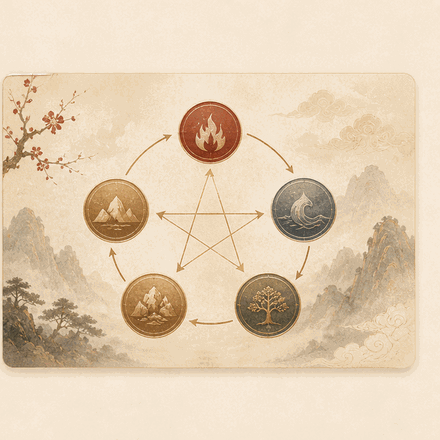
The Five Elements, known as Wu Xing (五行), are one of the most important foundations of Bazi. Wood, Fire, Earth, Metal, and Water are not only materials. They describe movement, rhythm, interaction, and symbolic qualities within a chart.
In Bazi, each Heavenly Stem and Earthly Branch carries elemental meaning. By studying the distribution and relationship of these elements, readers can understand how a chart expresses support, pressure, resource, output, and transformation.
Wood
Wood is traditionally associated with growth, planning, learning, flexibility, and upward movement. A strong Wood theme may suggest curiosity, persistence, and a desire to build or improve.
Fire
Fire is linked with visibility, warmth, expression, inspiration, and recognition. Fire can suggest enthusiasm, clarity, and the need to be seen or understood.
Earth
Earth is connected with stability, storage, trust, patience, and practical support. In a chart, Earth may point to groundedness, responsibility, and the ability to hold things together.
Metal
Metal is associated with structure, standards, precision, boundaries, and refinement. Metal can suggest discipline, judgment, and a preference for clarity and order.
Water
Water represents flow, wisdom, communication, adaptation, and hidden movement. A Water theme may suggest reflection, learning, strategy, and sensitivity to change.
Element Balance
Element balance does not mean every chart must contain equal amounts of each element. Instead, balance is understood through season, Day Master strength, chart structure, and the relationship between elements. A missing or repeated element should be interpreted within the whole system.
Using Five Elements for Reflection
For beginners, the Five Elements can become a useful language for self-awareness. They may suggest how a person learns, reacts, creates, organizes, or adapts. These ideas are best used as reflection prompts rather than fixed personality labels.
The Generating Cycle
The generating cycle describes support and continuation: Wood feeds Fire, Fire creates Earth, Earth bears Metal, Metal enriches Water, and Water nourishes Wood. In a chart, generating relationships may suggest where energy can flow smoothly or where one theme supports another.
The Controlling Cycle
The controlling cycle describes regulation: Wood controls Earth, Earth controls Water, Water controls Fire, Fire controls Metal, and Metal controls Wood. Control is not always negative. In traditional interpretation, it can also suggest structure, discipline, responsibility, and useful boundaries.
Strong, Weak, and Useful Elements
Beginners often ask whether a chart has too much or too little of an element. The better question is whether an element is useful in context. Season, Day Master strength, and the surrounding chart all matter. A repeated element may be supportive in one chart and excessive in another.
Bazinova explains element balance as a reflective framework. It may help someone notice habits, preferences, or pressure points, but it should not be used to judge health, destiny, or personal value.
Applying Element Language
Element language can be used in journaling, learning style, planning, and relationship reflection. For example, Wood may prompt questions about growth, Fire about expression, Earth about stability, Metal about structure, and Water about adaptability.
This content is for cultural, entertainment, and self-reflection purposes only. It should not be used as financial, medical, legal, or life-critical advice.
Bazinova cultural use note