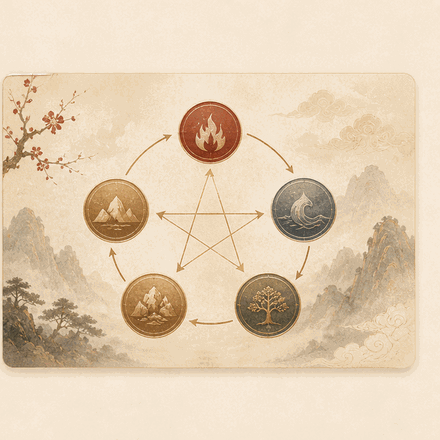
Reading a Bazi chart can feel complex at first because it combines time, symbols, elements, and relationships. A calm method helps beginners move step by step instead of trying to interpret everything at once.
This guide introduces a practical reading order for learners who want to understand Bazi (八字) without relying on fear-based or overly deterministic language.
Step 1: Identify the Four Pillars
Begin by locating the Year, Month, Day, and Hour pillars. Each pillar contains one Heavenly Stem and one Earthly Branch. Together, they form the eight characters of the chart.
The Year Pillar may reflect ancestral and social background, the Month Pillar is often linked with season and growth environment, the Day Pillar represents the self, and the Hour Pillar is traditionally associated with later expression and future potential.
Step 2: Find the Day Master
The Day Master is the Heavenly Stem of the Day Pillar. It is the central reference point of many Bazi interpretations. For example, if the Day Master is Yang Wood, the rest of the chart is often read in relation to the qualities of Wood and its surrounding elements.
Step 3: Review the Five Elements
Wood, Fire, Earth, Metal, and Water describe movement, balance, support, and tension. A chart with too much or too little of one element may traditionally suggest areas of emphasis or imbalance.
Element balance should be interpreted gently. It can suggest tendencies, but it does not define a person's worth, personality, or future.
Step 4: Look at Relationships Between Symbols
Stems, branches, and elements interact through generating, controlling, combining, and clashing relationships. These interactions can suggest how different themes in life support or challenge one another.
Step 5: Read Timing with Context
Luck pillars and annual cycles are traditionally used to study timing. On Bazinova, timing is explained as symbolic climate: it may indicate seasons of focus, transition, pressure, or opportunity, but it is not certain timing.
Beginner Reading Checklist
Start with chart structure, identify the Day Master, review the Five Elements, observe repeated symbols, then connect the reading to real-life context. This keeps the process useful and grounded.
Reading Order for Beginners
A beginner should not start by searching for every possible combination in the chart. First, confirm the four pillars and the Day Master. Second, observe the month branch because it provides the seasonal environment. Third, review whether the chart has strong repeated elements or missing themes. Fourth, look at interactions only after the basic structure is clear.
This order prevents a common mistake: treating one clash, combination, or symbolic phrase as the whole reading. Bazi works best when the reader sees proportion, context, and relationship between symbols.
Questions to Ask During a Reading
What element appears most often? Which element supports the Day Master? Which element creates pressure? Is the chart more expressive, structured, resource-oriented, practical, or collaborative? These questions help turn symbols into useful reflection.
When timing cycles are added, ask whether a period supports learning, rebuilding, visibility, responsibility, or change. Avoid turning timing into absolute prediction. A cycle can be treated as symbolic weather: it may describe the climate, but a person still chooses how to prepare and act.
Practical Notes
Keep a reading journal. Write down the chart structure, the strongest elements, the Day Master relationship, and two or three grounded observations. Over time, comparing charts will teach more than memorizing isolated meanings.
This content is for cultural, entertainment, and self-reflection purposes only. It should not be used as financial, medical, legal, or life-critical advice.
Bazinova cultural use note