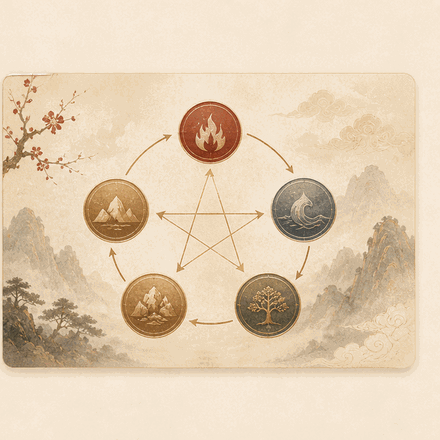
Bazi (八字), often translated as the Four Pillars of Destiny, is a traditional Chinese astrology system based on a person's birth year, month, day, and hour. Each pillar contains a Heavenly Stem (天干) and an Earthly Branch (地支), forming eight characters that describe symbolic patterns of time.
In traditional practice, Bazi is used to explore temperament, timing, relationships, and life tendencies. On Bazinova, it is presented as a cultural knowledge system for reflection rather than a certain prediction of fate.
Why Is It Called Four Pillars?
The four pillars are the Year Pillar, Month Pillar, Day Pillar, and Hour Pillar. They are traditionally associated with different layers of life context: early background, growth environment, the self, and later expression.
The Day Pillar is especially important because its Heavenly Stem is known as the Day Master. Many Bazi readings begin by understanding the Day Master and then comparing the rest of the chart to it.
What Can Bazi Suggest?
A Bazi chart may suggest patterns related to personality, decision style, learning rhythm, relationship tendencies, and symbolic timing cycles. These patterns are not certaintys. They are best read as a language for self-understanding.
For English-speaking learners and overseas Chinese readers, Bazi can also be a way to reconnect with Chinese metaphysical culture in a structured, modern, and grounded format.
How Should Beginners Use Bazi?
Start with the four pillars, then learn the Five Elements, Heavenly Stems, Earthly Branches, and Day Master. Avoid jumping too quickly into complex predictions. A useful reading should remain calm, practical, and respectful of real-life context.
FAQ
Is Bazi the same as Chinese zodiac?
No. The Chinese zodiac usually focuses on the birth year animal, while Bazi uses year, month, day, and hour together. It is a more detailed symbolic system.
Can Bazi predict the future?
Bazi may indicate traditional timing patterns, but it should not be treated as certain timingd future forecast. It is best used for cultural reference and self-reflection.
Is Bazi suitable for important decisions?
Bazi can support reflection, but it should not replace professional advice, personal judgment, or real-world planning.
How Bazi Differs from Western Astrology
Western astrology usually begins with planets, signs, houses, and aspects. Bazi begins with the calendar structure of birth time. It studies the relationship between Heavenly Stems, Earthly Branches, the Five Elements, and seasonal strength. Both systems can be used for reflection, but they use different symbolic languages.
For beginners, this difference matters because Bazi is not only about a single sign or animal. A person born in the same Chinese zodiac year may have a very different Bazi chart because the month, day, and hour pillars change the full pattern.
What a Bazi Chart Includes
A complete chart normally includes four pillars, hidden stems, element distribution, Ten Gods relationships, and timing cycles. These layers help explain why Bazi readings can feel detailed. They also show why responsible interpretation should look at the whole chart instead of one isolated symbol.
Bazinova keeps Chinese terms visible alongside English explanations so learners can gradually build vocabulary. Terms such as Day Master, Heavenly Stem, Earthly Branch, Ten Gods, and Luck Pillars become easier once they are seen as connected parts of the same system.
Responsible Use
A useful Bazi reading should help a person ask better questions. It may highlight strengths, repeated patterns, timing themes, or areas that deserve more attention. It should not create fear, dependency, or rigid labels. The best use of Bazi is calm reflection combined with real-life responsibility.
This content is for cultural, entertainment, and self-reflection purposes only. It should not be used as financial, medical, legal, or life-critical advice.
Bazinova cultural use note