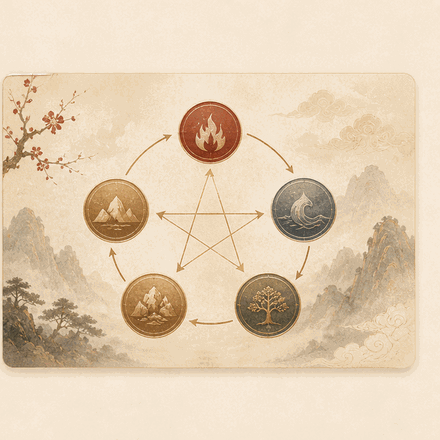
The Ten Gods are one of the most useful parts of Bazi. They explain how the other elements in a chart relate to the Day Master.
Despite the name, the Ten Gods are not deities. They are relationship categories. They help turn a chart from symbols into roles, such as support, expression, money, pressure, responsibility, and competition.
Quick Answer
The Ten Gods in Bazi are ten relationship roles calculated from the Day Master. They describe how each element functions in a chart, including support, expression, wealth, discipline, and peer influence.
Why the Ten Gods Depend on the Day Master
The Ten Gods are always calculated from the Day Master. If the Day Master changes, the Ten Gods change.
For example, for a Wood Day Master:
- Water is Resource because Water supports Wood.
- Fire is Output because Wood produces Fire.
- Earth is Wealth because Wood controls Earth.
- Metal is Officer because Metal controls Wood.
- Wood is Peer because it matches the Day Master.
This relationship logic is the foundation of Ten Gods reading.
The Five Main Categories
The ten roles can be grouped into five pairs.
Resource
Resource represents support, learning, protection, memory, background, and nourishment. It can show teachers, study, documents, qualifications, or a person's ability to absorb information.
Too much Resource can also become dependence, hesitation, or overthinking.
Output
Output represents expression, production, creativity, skill, speech, and what the Day Master releases into the world.
Healthy Output can show talent and usefulness. Excessive Output may drain the Day Master or resist structure.
Wealth
Wealth represents what the Day Master manages, controls, uses, or pursues. It may connect to money, practical resources, business, ownership, and responsibility.
Wealth is not automatically money luck. The chart must show whether the Day Master can handle it.
Officer
Officer represents discipline, standards, pressure, rules, status, responsibility, and structure. It may connect to career systems, authority, reputation, and self-control.
When balanced, Officer can bring order. When harsh or unsupported, it may feel like pressure.
Peer
Peer represents people similar to the Day Master: friends, competitors, siblings, colleagues, independence, and self-assertion.
Peer can help a weak Day Master, but it can also compete for resources or divide Wealth.
The Ten Specific Gods
Each main category has a Yin and Yang version:
| Category | Ten Gods |
|---|---|
| Resource | Direct Resource, Indirect Resource |
| Output | Eating God, Hurting Officer |
| Wealth | Direct Wealth, Indirect Wealth |
| Officer | Direct Officer, Seven Killings |
| Peer | Friend, Rob Wealth |
The difference between each pair depends on Yin and Yang relationship. Beginners should first understand the category before memorizing every detail.
How to Read Ten Gods in a Chart
Use these questions:
- Which Ten Gods are visible in the Heavenly Stems?
- Which are hidden in the Earthly Branches?
- Which are strong because of season or roots?
- Which are missing or weak?
- Which are helpful for the Day Master?
- Which become excessive or stressful?
Do not read a Ten God in isolation. A chart with strong Wealth but weak Day Master is different from a chart with strong Wealth and strong support.
Example
If a chart has strong Output and Wealth, it may suggest a person who turns skill into practical results. This can support careers in teaching, consulting, design, content, sales, craft, or entrepreneurship.
But if the Day Master is weak and Resource is missing, the same pattern may feel tiring. The person may produce a lot but struggle to recover.
Common Mistakes
The biggest mistake is calling one Ten God always helpful and another always difficult. Another mistake is assuming that Wealth always means money or Officer always means career.
Ten Gods are roles. Their usefulness depends on chart structure.
FAQ
Are the Ten Gods the same for everyone?
No. They are calculated from the Day Master, so each chart has its own relationship map.
Which Ten God is best?
No Ten God is always best. A role is useful when it supports the chart's balance and purpose.
Should beginners memorize all Ten Gods first?
Start with the five categories: Resource, Output, Wealth, Officer, and Peer. Then learn the ten specific names.
This content is for cultural, entertainment, and self-reflection purposes only. It should not be used as financial, medical, legal, or life-critical advice.
Bazinova cultural use note