The Day Master is one of the most important ideas in Bazi. It is the Heavenly Stem of the Day Pillar, and it becomes the reference point for reading the rest of the chart.
If you are new to Bazi, think of the Day Master as the "center" of the chart. It does not describe everything about you by itself. Instead, it tells us how all other elements relate to you.
Quick Answer
In Bazi, the Day Master is the Heavenly Stem of your Day Pillar. It is used as the reference point for reading the Five Elements and Ten Gods in the rest of the chart.
Where to Find the Day Master
A Bazi chart has four pillars:
- Year Pillar
- Month Pillar
- Day Pillar
- Hour Pillar
Each pillar has a Heavenly Stem on top and an Earthly Branch below. The top symbol of the Day Pillar is the Day Master.
For example:
- Jia Zi Day means Jia Wood Day Master.
- Ding You Day means Ding Fire Day Master.
- Ren Chen Day means Ren Water Day Master.
Most Bazi calculators will label the Day Master clearly.
The Ten Possible Day Masters
There are ten Heavenly Stems, so there are ten Day Masters:
| Day Master | Element | Yin or Yang |
|---|---|---|
| Jia | Wood | Yang |
| Yi | Wood | Yin |
| Bing | Fire | Yang |
| Ding | Fire | Yin |
| Wu | Earth | Yang |
| Ji | Earth | Yin |
| Geng | Metal | Yang |
| Xin | Metal | Yin |
| Ren | Water | Yang |
| Gui | Water | Yin |
Each has a symbolic quality. Jia Wood is often compared to a tree. Yi Wood to vines or flowers. Bing Fire to the sun. Ding Fire to candlelight. These images help beginners, but they are not enough for a full reading.
Why the Day Master Matters
The Day Master determines the Ten Gods.
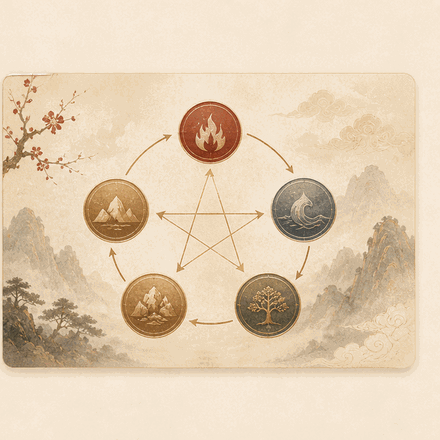
For example, if your Day Master is Wood:
- Water supports Wood, so Water becomes Resource.
- Wood matches Wood, so Wood becomes Peer.
- Fire is produced by Wood, so Fire becomes Output.
- Earth is controlled by Wood, so Earth becomes Wealth.
- Metal controls Wood, so Metal becomes Officer.
If your Day Master changes, the meaning of every other element changes too.
This is why two people with the same element in a chart may have different interpretations. The element's role depends on the Day Master.
Day Master Is Not a Personality Label
A common beginner mistake is reading the Day Master like a zodiac sign. For example, "Jia Wood people are always this" or "Ding Fire people are always that."
Bazi is more contextual. A Jia Wood Day Master born in spring with strong Water support is different from Jia Wood born in summer with heavy Fire. A weak Day Master and a strong Day Master may express the same stem differently.
The better question is: what condition is the Day Master in?
What to Check After Finding It
After identifying the Day Master, check:
- 1. Season: Is the Day Master born in a supportive season?
- 2. Roots: Does the Day Master have support in the Earthly Branches?
- 3. Resource: Is there an element that nourishes it?
- 4. Pressure: Is there strong control or draining energy?
- 5. Balance: Does the chart flow or become stuck?
This gives a more useful reading than Day Master symbolism alone.
Day Master and Life Themes
The Day Master helps read personality, work style, relationship patterns, learning style, and stress patterns. But it should always be read with the whole chart.
For example, strong Output around the Day Master may suggest expression or creativity. Strong Officer may suggest pressure, structure, rules, or responsibility. Strong Resource may suggest study, support, protection, or reflection.
The Day Master tells us who these forces are acting around.
FAQ
Is the Day Master the same as my zodiac sign?
No. The zodiac sign is usually connected to the Year Branch. The Day Master comes from the Day Pillar and is more central in Bazi reading.
Can the Day Master change?
Your natal Day Master does not change. Luck Pillars and annual cycles change the conditions around it.
Which Day Master is best?
There is no best Day Master. Every Day Master can be balanced, stressed, supported, or expressive depending on the whole chart.
This content is for cultural, entertainment, and self-reflection purposes only. It should not be used as financial, medical, legal, or life-critical advice.
Bazinova cultural use note