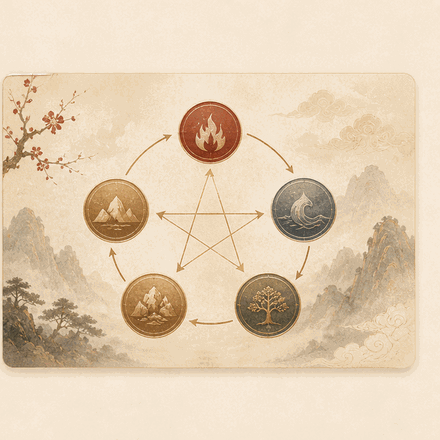
A Bazi chart can look confusing when you first see it. There are stems, branches, elements, hidden stems, Ten Gods, and timing cycles. The best way to begin is not to memorize every symbol at once. Read the chart in a calm order.
This example uses a simple learning method. The goal is not to make a final life judgment. The goal is to show how a Bazi reader moves from symbols to interpretation.
Quick Answer
A beginner Bazi chart reading usually starts with the Day Master, then checks the Month Branch, season, roots, Five Elements, Ten Gods, and timing cycles. The example below shows that order in practice.
Example Chart
For learning purposes, imagine a chart with the following structure:
| Pillar | Heavenly Stem | Earthly Branch |
|---|---|---|
| Year | Ren Water | Shen Metal |
| Month | Bing Fire | Wu Fire |
| Day | Jia Wood | Yin Wood |
| Hour | Ji Earth | Si Fire |
The Day Master is Jia Wood because Jia is the Heavenly Stem of the Day Pillar.
This is a teaching example, not a real person's full reading. A real reading should also check exact birth data, calendar conversion, hidden stems, and current timing cycles.
Step 1: Start With the Day Master
Jia Wood is often compared to a large tree. Symbolically, it suggests growth, direction, planning, principle, and the desire to stand upright.
But this does not mean the person is always confident or steady. The Day Master must be read in context. A tree in spring, summer, autumn, or winter faces different conditions.
Step 2: Look at the Month Branch
The Month Branch in this example is Wu Fire, which belongs to summer. This matters because season shows the climate of the chart.
Jia Wood born in strong Fire season may be expressive, visible, and active, but Wood can also be drained by too much Fire. In Bazi language, Fire is Output for a Wood Day Master. Output represents expression, talent, production, and release.
So the chart begins with a clear theme: the Day Master has strong Output energy.
Step 3: Check Support and Pressure
Jia Wood is supported by Wood and Water. In this example, the Day Branch is Yin Wood, which gives the Day Master a root. The Year Stem is Ren Water, which can support Wood.
At the same time, Fire is strong in the Month Branch and Hour Branch. This means the chart has strong expressive force. The person may be drawn to creating, explaining, performing, teaching, designing, or producing visible work.
The question is whether the chart has enough support to keep that output sustainable.
Step 4: Translate Elements Into Ten Gods
For Jia Wood:
- Water is Resource.
- Wood is Peer.
- Fire is Output.
- Earth is Wealth.
- Metal is Officer.
In this example, Output is prominent because Fire appears strongly. Wealth also appears through Ji Earth in the Hour Stem. This can suggest a path where skills, ideas, or expression lead to practical results.
The Year Branch Shen Metal adds Officer energy, which may bring rules, pressure, standards, or institutional expectations.
Step 5: Avoid Jumping to Conclusions
It would be too simple to say, "Strong Fire means creative success." A better reading asks:
- Is the Day Master supported enough?
- Is Output too strong or well used?
- Does Wealth appear as a result of Output?
- Does Officer energy provide structure or pressure?
- Which Luck Pillars activate these themes?
Bazi interpretation is not a single symbol. It is a pattern.
Step 6: Connect the Reading to Real Life
For a learning example, this chart may suggest a person who needs to express ideas, make things visible, and turn knowledge into practical output. Career fields involving education, media, design, consulting, strategy, or communication could feel natural if the broader chart supports them.
But if the person feels burned out, scattered, or overexposed, the same Fire-heavy pattern might show the need for stronger Resource habits: rest, learning, mentoring, reflection, and better systems.
Step 7: Add Timing Later
After reading the natal chart, you can compare the Luck Pillars and annual cycles. A Water or Wood cycle may strengthen support. A Fire cycle may increase visibility and output. An Earth cycle may bring practical responsibilities, money questions, or resource management.
Timing does not replace the chart. It activates parts of it.
Reading Order Summary
Use this order for your own chart:
- 1. Find the Day Master.
- 2. Read the Month Branch and season.
- 3. Check roots and support.
- 4. Translate elements into Ten Gods.
- 5. Identify the strongest theme.
- 6. Look for balance and pressure.
- 7. Add Luck Pillars only after the structure is clear.
FAQ
Can one example explain all Bazi charts?
No. A sample chart teaches reading order. Real interpretation depends on the full chart and timing layers.
Should beginners read Ten Gods first?
Ten Gods are useful, but they should be read after identifying the Day Master and seasonal context.
Why is the Month Pillar important?
The Month Pillar shows season and social environment. It often carries strong influence over chart structure.
This content is for cultural, entertainment, and self-reflection purposes only. It should not be used as financial, medical, legal, or life-critical advice.
Bazinova cultural use note