A Bazi calculator turns a birth date and time into a Four Pillars chart. It is the starting point for reading Bazi, also called the Four Pillars of Destiny, because the chart shows the symbolic pattern formed by the year, month, day, and hour of birth.
The calculator does not replace interpretation. It gives you the chart structure. The reading begins after that, when you understand what the pillars, elements, Day Master, Ten Gods, and timing cycles are pointing to.
Quick Answer
To use a Bazi calculator, enter your birth date, birth time, birth location, and the required chart settings. Then read the result in order: Four Pillars, Day Master, Five Elements, Ten Gods, and Luck Pillars. The calculator gives the chart; interpretation comes from how these layers relate to one another.
What a Bazi Calculator Usually Needs
Most Bazi calculators ask for four details:
- Date of birth
- Time of birth
- Birth location
- Sex or gender, mainly for luck cycle direction in some systems
The time and location matter because Bazi uses traditional calendar rules. A person born near midnight, near a seasonal transition, or in a different time zone may receive a different chart than expected. If the birth time is uncertain, treat the result as a learning reference rather than a final chart.
Step 1: Generate the Four Pillars
After entering your birth information, the calculator produces four pillars:
- Year Pillar
- Month Pillar
- Day Pillar
- Hour Pillar
Each pillar contains one Heavenly Stem and one Earthly Branch. Together, the four pillars form the "eight characters" of Bazi.
The Year Pillar often describes broad background and early environment. The Month Pillar is especially important because it reflects season and life context. The Day Pillar contains the Day Master, which becomes the reference point for the whole chart. The Hour Pillar often adds deeper potential, later-life themes, and long-term development.
Step 2: Find the Day Master
The Day Master is the Heavenly Stem of the Day Pillar. It is the center of most Bazi interpretation.
For example, if the Day Pillar is Jia Zi, the Day Master is Jia Wood. If the Day Pillar is Ding You, the Day Master is Ding Fire.
The Day Master is not your entire personality. It is the reference point that tells us how the rest of the chart relates to you. The other elements become Resource, Output, Wealth, Officer, or Peer depending on their relationship to the Day Master.
Step 3: Look at the Five Elements
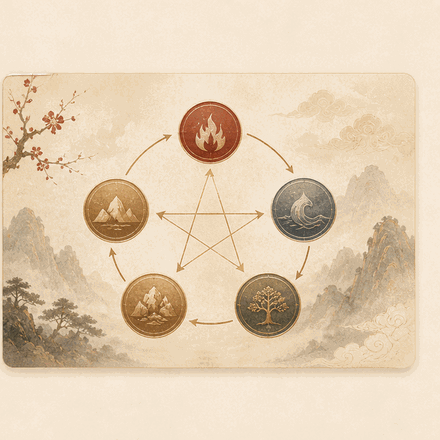
A calculator may show how much Wood, Fire, Earth, Metal, and Water appear in the chart. This is useful, but do not read it too mechanically.
Element balance is not only about counting symbols. Season matters. Hidden stems matter. Support and pressure matter. A chart with two Fire signs in winter may feel different from a chart with two Fire signs in summer.
Use element balance as a first map:
- Wood suggests growth, planning, learning, and direction.
- Fire suggests visibility, expression, warmth, and recognition.
- Earth suggests stability, trust, storage, and practical grounding.
- Metal suggests structure, standards, refinement, and decision.
- Water suggests movement, reflection, intelligence, and adaptability.
Step 4: Read the Ten Gods
The Ten Gods are relationship labels based on the Day Master. They turn elements into roles.
For a beginner, the five main categories are enough:
- Resource: what supports and teaches you
- Output: what you express or create
- Wealth: what you manage, use, or pursue
- Officer: what disciplines, pressures, or organizes you
- Peer: what mirrors, competes with, or accompanies you
Do not treat any Ten God as automatically helpful or difficult. A useful reading asks whether that role is balanced, excessive, missing, supported, or under pressure.
Step 5: Check Luck Cycles Carefully
Many calculators also show Luck Pillars or annual cycles. These timing layers are used to study changing conditions over time.
A useful beginner rule is simple: do not jump straight to timing claims. First understand the natal chart. Then compare the current Luck Pillar and year to see which parts of the chart are being activated.
Common Mistakes
The most common mistake is reading the chart like a personality quiz. Bazi is more structured than that. Another mistake is assuming that a missing element always means a problem, or that a strong element is always lucky.
The calculator gives symbols. Interpretation comes from relationships, timing, context, and careful language.
Next Step
Use the Bazinova Bazi Calculator to generate your chart, then read the result in this order:
- 1. Identify the Day Master.
- 2. Observe the Month Branch and season.
- 3. Review Five Element balance.
- 4. Read the Ten Gods.
- 5. Look at Luck Pillars only after the basic structure is clear.
After that, compare your result with a step-by-step chart example so the symbols become easier to connect.
FAQ
Is a Bazi calculator accurate?
A calculator can accurately convert birth information into a chart when the input data and calendar rules are correct. Interpretation still requires judgment.
Do I need my exact birth time?
Exact time is best. If the hour is unknown, you can still study the first three pillars, but the chart is incomplete.
Is Bazi used for fortune telling?
Bazi can be used in different ways. Bazinova presents it as cultural learning, symbolic reflection, and structured self-study, not as a promise of single final answers.
This content is for cultural, entertainment, and self-reflection purposes only. It should not be used as financial, medical, legal, or life-critical advice.
Bazinova cultural use note